The Importance of
Art in Child Development
By Grace Hwang Lynch
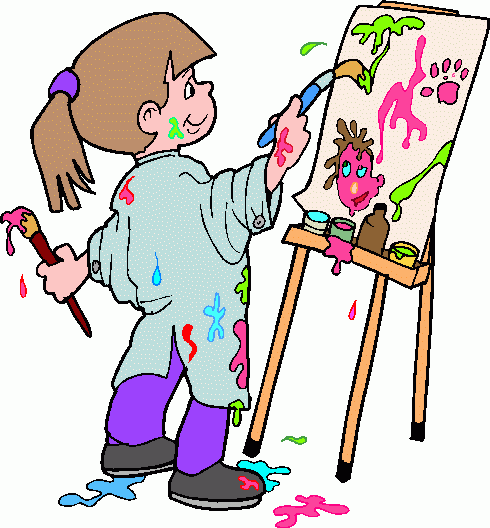
School
curricula have shifted heavily toward common core subjects of reading and math,
but what about the arts? Although some may regard art education as a luxury,
simple creative activities are some of the building blocks of child
development. Learning to create and appreciate visual aesthetics may be more
important than ever to the development of the next generation of children as
they grow up.
Developmental Benefits of Art
Motor Skills: Many of the motions involved in making art,
such as holding a paintbrush or scribbling with a crayon, are essential to the
growth of fine motor skills in young children. According to the National
Institutes of Health, developmental milestones around age three should include
drawing a circle and beginning to use safety scissors. Around age four,
children may be able to draw a square and begin cutting straight lines with
scissors. Many preschool programs emphasize the use of scissors because it
develops the dexterity children will need for writing.
Language Development: For very young children, making
art—or just talking about it—provides opportunities to learn words for colors,
shapes and actions. When toddlers are as young as a year old, parents can do
simple activities such as crumpling up paper and calling it a “ball.” By
elementary school, students can use descriptive words to discuss their own
creations or to talk about what feelings are elicited when they see different
styles of artwork.
Decision Making: According to a report by Americans
for the Arts, art education strengthens problem-solving and critical-thinking
skills. The experience of making decisions and choices in the course of
creating art carries over into other parts of life. “If they are exploring and
thinking and experimenting and trying new ideas, then creativity has a chance
to blossom,” says MaryAnn Kohl, an arts educator and author of numerous books
about children’s art education.
Visual Learning: Drawing, sculpting with clay and
threading beads on a string all develop visual-spatial skills, which are more
important than ever. Even toddlers know how to operate a smart phone or tablet,
which means that even before they can read, kids are taking in visual
information. This information consists of cues that we get from pictures or
three-dimensional objects from digital media, books and television.
Inventiveness: When kids are encouraged to express themselves
and take risks in creating art, they develop a sense of innovation that will be
important in their adult lives. “The kind of people society needs to make it
move forward are thinking, inventive people who seek new ways and improvements,
not people who can only follow directions,” says Kohl. “Art is a way to
encourage the process and the experience of thinking and making things better!”
Cultural Awareness: As we live in an increasingly
diverse society, the images of different groups in the media may also present
mixed messages. “If a child is playing with a toy that suggests a racist or
sexist meaning, part of that meaning develops because of the aesthetics of the
toy—the color, shape, texture of the hair,” says Freedman. Teaching children to
recognize the choices an artist or designer makes in portraying a subject helps
kids understand the concept that what they see may be someone’s interpretation
of reality.
Improved Academic Performance: Studies show that there is a
correlation between art and other achievement. A report by Americans for the
Arts states that young people who participate regularly in the arts (three
hours a day on three days each week through one full year) are four times more
likely to be recognized for academic achievement, to participate in a math and
science fair or to win an award for writing an essay or poem than children who
do not participate.
Fuente: Clic aquí
COMENTARIO:
El texto es escrito por Graciela Hwang Lynch, y trata sobre los beneficios del arte en el desarrollo de los niños.
Siempre se ha dado mayor énfasis en las materias de lenguaje y matemática, dejando a las artes de lado. Mucho de eso se da por no saber lo importante que puede llegar a ser el arte para el desarrollo del niño.
Pienso que la importancia que le demos a la enseñanza del arte depende de todos los docentes, y lo que pueda aportar va a ser según cómo se enseñe.
QUESTIONS:
1- What are the benefits of art by Grace Hwang Lynch?
2- Art help the developer of the language. Why?
3- How old is better to learn art?
4- Do you think art is a good way to express? Why?
COMENTARIO:
El texto es escrito por Graciela Hwang Lynch, y trata sobre los beneficios del arte en el desarrollo de los niños.
Siempre se ha dado mayor énfasis en las materias de lenguaje y matemática, dejando a las artes de lado. Mucho de eso se da por no saber lo importante que puede llegar a ser el arte para el desarrollo del niño.
Pienso que la importancia que le demos a la enseñanza del arte depende de todos los docentes, y lo que pueda aportar va a ser según cómo se enseñe.
QUESTIONS:
1- What are the benefits of art by Grace Hwang Lynch?
2- Art help the developer of the language. Why?
3- How old is better to learn art?
4- Do you think art is a good way to express? Why?

There is no reference to who posted this article, which is very interesting indeed! Please add your name in the comments section. Thanks!
ResponderEliminarhttp://www.pbs.org/parents/education/music-arts/the-importance-of-art-in-child-development/
Eliminar